Imagine you’re on a Sunday afternoon, scanning an arbitrage opportunity across Ethereum and Arbitrum. The UI on the DEX looks clean, the numbers line up, and the gas estimate is tolerable. You click “Confirm” in your wallet—and only afterward realize the contract would have drained an approval you’d forgotten, or the swap would route through a tiny pool and trigger massive slippage. That “blind signing” moment is exactly the practical risk Rabby’s Chrome extension aims to cut down with transaction simulation.
This article walks through how Rabby’s transaction-simulation model works inside a Chromium browser extension, what it actually prevents (and what it cannot), how it compares to leading alternatives, and a compact decision framework for DeFi power users in the US considering Rabby as their daily driver wallet.
How transaction simulation works, step by step
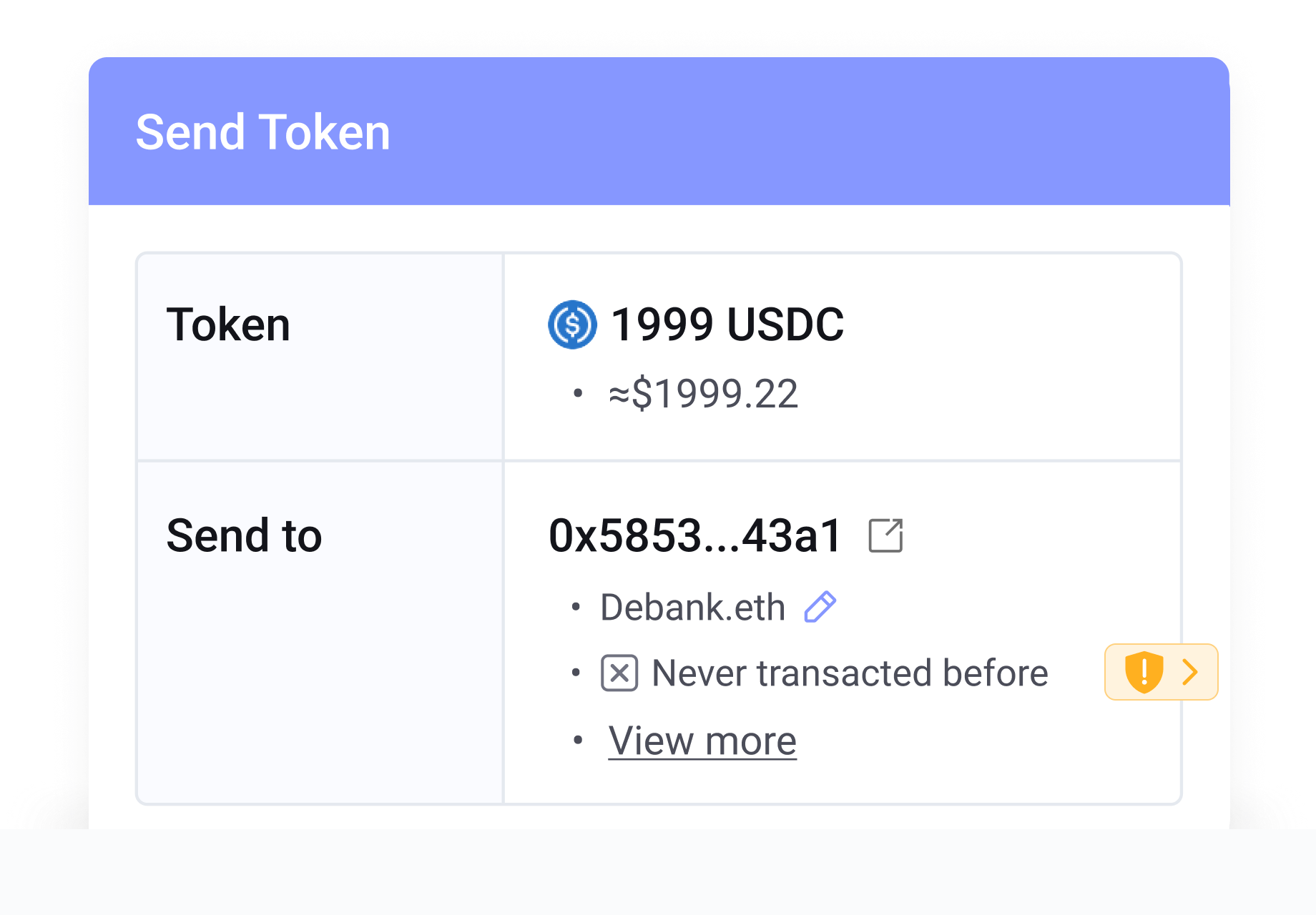
At its core, transaction simulation is a local—sometimes remote-assisted—dry run of the exact transaction data before a private key signs it. Rabby intercepts the transaction payload when a dApp triggers a request and executes a deterministic simulation of what will happen on-chain: token transfers, approval state changes, and the gas math. The result is presented to the user as an explicit delta—estimated token balance changes and fees—rather than an opaque “Approve” button.
Mechanistically, simulation depends on reading the current on-chain state (balances, allowances, nonces), decoding the calldata to identify function calls (swapExactTokensForTokens, approve, multicall, etc.), and invoking the same EVM logic locally or via a node to project outcomes. Rabby supplements this with a security engine that flags historically compromised contracts, suspicious approval patterns, nonexistent recipients, or uncommon patterns that correlate with exploit vectors.
What Rabby prevents well — and where it still leaves gaps
Transaction simulation directly reduces several common failure modes for active DeFi users:
– Blind signing: you see exact balance deltas and fees before signing, removing guesswork about what a contract will do.
– Dangerous approvals: the built-in revocation tool plus pre-transaction scanning highlights when a transaction will create or expand a token allowance to a counterparty.
– Cross-network mistakes: automatic network switching combined with simulation reduces erroneous submits on the wrong chain.
But simulation is not a catch-all. There are important limitations to understand before treating it as a substitute for operational discipline:
– Simulation relies on current chain state and deterministic code paths. If a contract calls an off-chain oracle or depends on a rapidly changing mempool state, the simulated outcome may diverge from actual execution—especially during volatile periods.
– A simulation cannot undo a signed transaction; it only informs the decision. User error, social engineering (e.g., approving a malicious dApp intentionally), or compromise of the host machine still results in loss.
– Rabby’s simulation flags known risky contracts based on prior incidents, but novel exploits or logic flaws in previously benign contracts remain an open risk vector.
Rabby vs. alternatives: where the trade-offs lie
Power users often weigh Rabby against MetaMask, Trust Wallet, or Coinbase Wallet. The left column of the trade-off is security visibility: Rabby’s real differentiator is transaction simulation and the explicit presentation of token deltas, plus pre-transaction scanning and approval revocation tools. These features give a cognitive affordance: fewer surprises when signing complex DeFi transactions.
On the other side, incumbents can offer other conveniences: MetaMask has the deepest ecosystem integration and a broader familiarity among dApps; Coinbase Wallet integrates smoothly with a regulated exchange for fiat flows; Trust Wallet optimizes mobile ergonomics. Rabby deliberately trades some friction (extra UI steps, explicit simulation displays) for better decision information.
Institutional users find additional value in Rabby’s integrations with Gnosis Safe, Fireblocks, and similar custody tools. Those integrations make Rabby plausible as part of an enterprise flow where multiple signatures and programmatic policies are required, although Rabby lacks native on-ramp fiat purchases and in-wallet staking—meaning institutions still need partner services for some asset operations.
Security history matters — how to read the 2022 incident
No wallet is perfectly safe; Rabby’s 2022 Rabby Swap contract exploit (~$190,000) is a case in point. Two lessons matter here. First, damage happens at the smart-contract layer and can involve third-party code—wallets can mitigate but not eliminate that exposure. Second, Rabby’s response (freezing the contract, compensating users, increasing audits) is evidence of operational maturity: the team acted to contain loss and invest in security reviews. That response is a positive signal but not a guarantee against future flaws.
For US-based advanced users, that history should inform an operational rule: treat any wallet as part of a broader risk-control stack—hardware wallets for high-value holdings, separate “hot” wallets for routine DeFi interaction, and periodic allowance revocation audits.
Practical heuristics and a decision framework for power users
Here are four lightweight heuristics to turn the prior analysis into action:
1) Use simulation as a gating function, not a fallback. If Rabby’s simulation flags unusual deltas or unknown recipients, pause and inspect the calldata or run the same call in a block explorer/debugger.
2) Segment assets by purpose. Keep long-term holdings on a hardware-backed wallet integrated with Rabby (Ledger/Trezor). Use a Rabby browser profile for active trading and connect the hardware device when signing higher-value operations.
3) Schedule allowance hygiene. Make revocation a ritual: monthly scans of active approvals and batch revocations where appropriate reduce attack surface.
4) Treat cross-chain gas carefully. Use Rabby’s gas top-up for practical convenience, but validate cross-chain flows and the counterparty contract when bridging value—bridges remain a systemic risk in DeFi.
Where to watch next
Short-term signals that would change the calculus include more aggressive on-chain simulation features (e.g., mempool-aware worst-case slippage modeling), built-in fiat on-ramps inside the wallet, or standardized transaction meta-schemas that make simulation data interoperable between wallets and third-party auditors. Conversely, a rise in sophisticated social-engineering attacks that mimic legitimate dApp flows would increase the relative value of hardware-backed signing and institutional controls.
For a practical next step if you want to test Rabby’s transaction simulation in your browser setup, the project’s user-facing material is available here.
FAQ
Does Rabby’s simulation guarantee I won’t lose funds?
No. Simulation reduces the probability of “blind signing” mistakes by showing expected token deltas and fees before signing, but it cannot prevent losses caused by compromised machines, sophisticated contract exploits unknown at simulation time, or users who intentionally approve malicious transactions. Use simulation as a decision-support tool within a larger security posture (hardware wallets, multi-sig, allowance revocation).
How does Rabby work with hardware wallets for safer signing?
Rabby integrates with Ledger, Trezor, Keystone, and other devices so that the private key operations occur on the hardware device while Rabby handles state reading, simulation, and UI. This pairing preserves simulation benefits while moving the signing operation to an isolated environment—recommended for high-value or institutional flows.
Will simulation slow down my trades?
There is a small time cost: Rabby must read on-chain state and run a deterministic execution. For routine swaps, the delay is usually a fraction of a second to a couple of seconds. In highly time-sensitive strategies—e.g., arbitrage where mempool order matters—simulation may not reflect microsecond timing and you should explicitly account for slippage and execution risk.
Can Rabby prevent approval-based rug pulls?
Rabby helps by showing approval changes and by offering a native revocation tool, but it cannot stop a user from granting an approval deliberately. The wallet reduces accidental exposure and makes it easier to correct past approvals, which materially reduces risk for many users.